Useful information
Address
PLATEFORME 10 - Place de la Gare 16
1003 Lausanne
Schedules
Free
On 24 and 31 December: 10am to 5pm.
Closed on 25 December and 1 January.
Access
CFF train station: 3 minutes on foot
Bus 1, 3, 21, 60: «Lausanne-Gare» stop
Bus 6: «Cécil» stop
Metro M2: «Lausanne-Gare» stop
More info
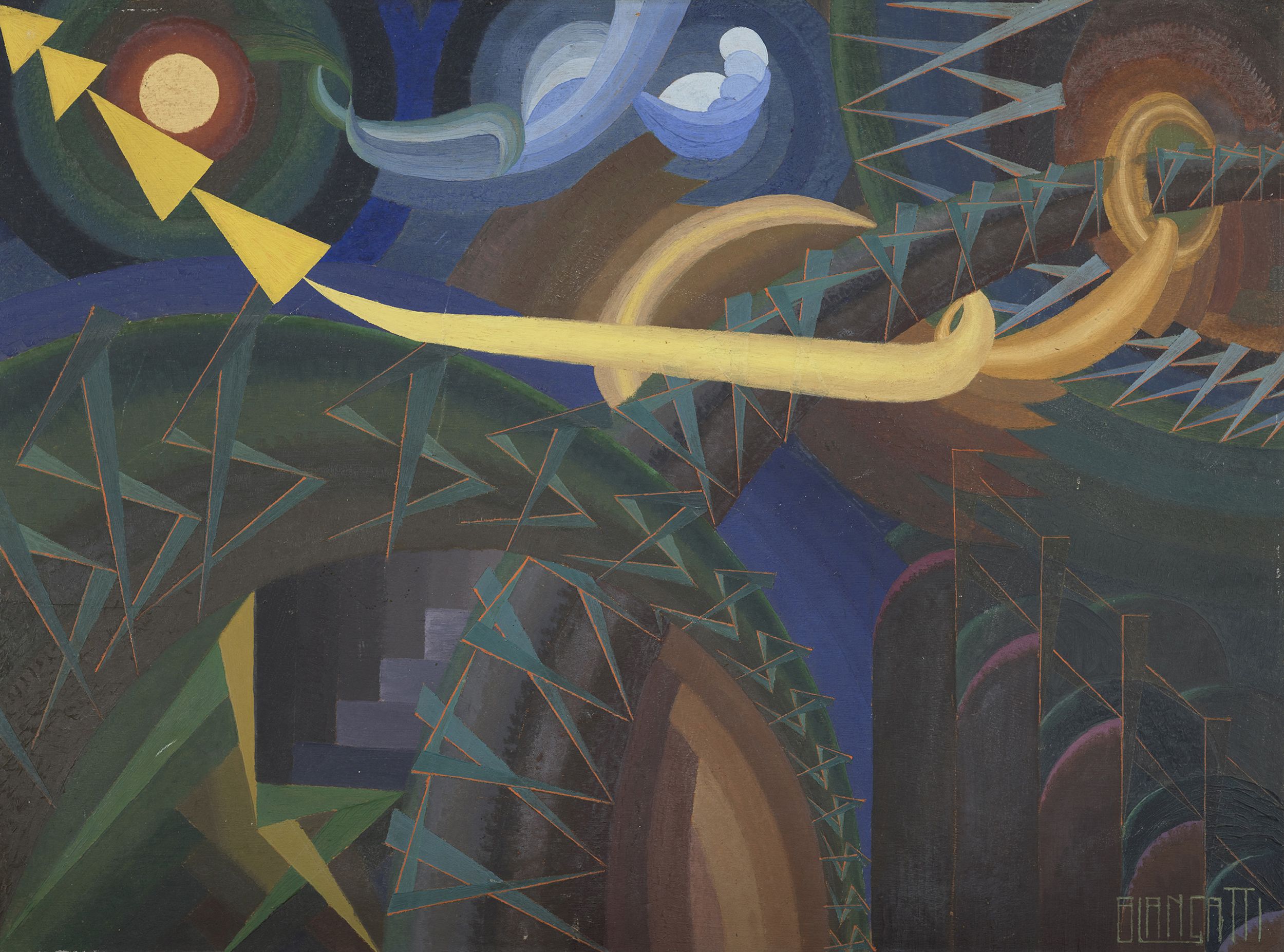
MCBA holds over forty paintings, works on paper, and notebooks by Charles Blanc-Gatti. The acquisition of a group of nine paintings in 2023 provides an opportunity to revisit the atypical career of this native of Lausanne and delve into the most inspired pieces by an artist who was convinced of the predominance of the eyes and ears, the visual and auditory senses.
In 1911, on the eve of the First World War, Blanc-Gatti settled in Paris, where he worked as a draughtsman-technician. Various factions of the avant-garde were facing off in the City of Lights, where the new century seemed to be at its most fervent and fertile. Orphism and Futurism made a particular impact on Blanc-Gatti and would influence his most abstract works. Following a short stay in Lausanne, where he was active as a fashion illustrator, he returned to the French capital and was to live and work there from 1924 to 1936. Throughout the interwar years, he transposed works by the great classic, Romantic and modern composers, from Bach, Chopin, and Rimsky-Korsakov, to Saint-Saëns, Ravel, and Honegger.
In 1932 Blanc-Gatti founded the Association of Musicalist Artists with Henry Valensi, Gustave Bourgogne, and Vito Stracquadaini. Published soon after, the group’s manifesto drew a wide response. Driven by the progress made in physics and experimental psychology, “Musicalism”, in the age of modernity, took over from the preceding century’s interest in different forms of synaesthesia and the Gesamtkunstwerk, the total work of art.
In the years that followed, Blanc-Gatti spread his message to domains as varied as the stage, advertising, and film, exploring the dynamic translation of sound morphology, forging correspondences between the vibrations of sound and light, and graphically transcribing the length, frequency and movement of sound waves. In 1933 he patented his idea for a “Chromophonic Orchestra”, conjuring up in his imagination concerts accompanied by light projections. He returned to Switzerland in 1936 and made Chromophony (1939), the only application of his theories in film. Living and working in Montreux, he opened a studio for animated advertisements in 1938.
Blanc-Gatti settled in Verbier in 1947 and later moved again to Riex in 1952. Until his death, he carried on with his work as a figurative landscape artist, a form of expression he had begun practicing in his youth. His series depicting church steeples, it should be noted, also joins sound and colour whilst renewing Alpine iconography. In 1953 the artist gave up painting and devoted himself entirely to promoting Musicalism.